Project: Developing the Ciliwung Watershed Management
August 02, 2015
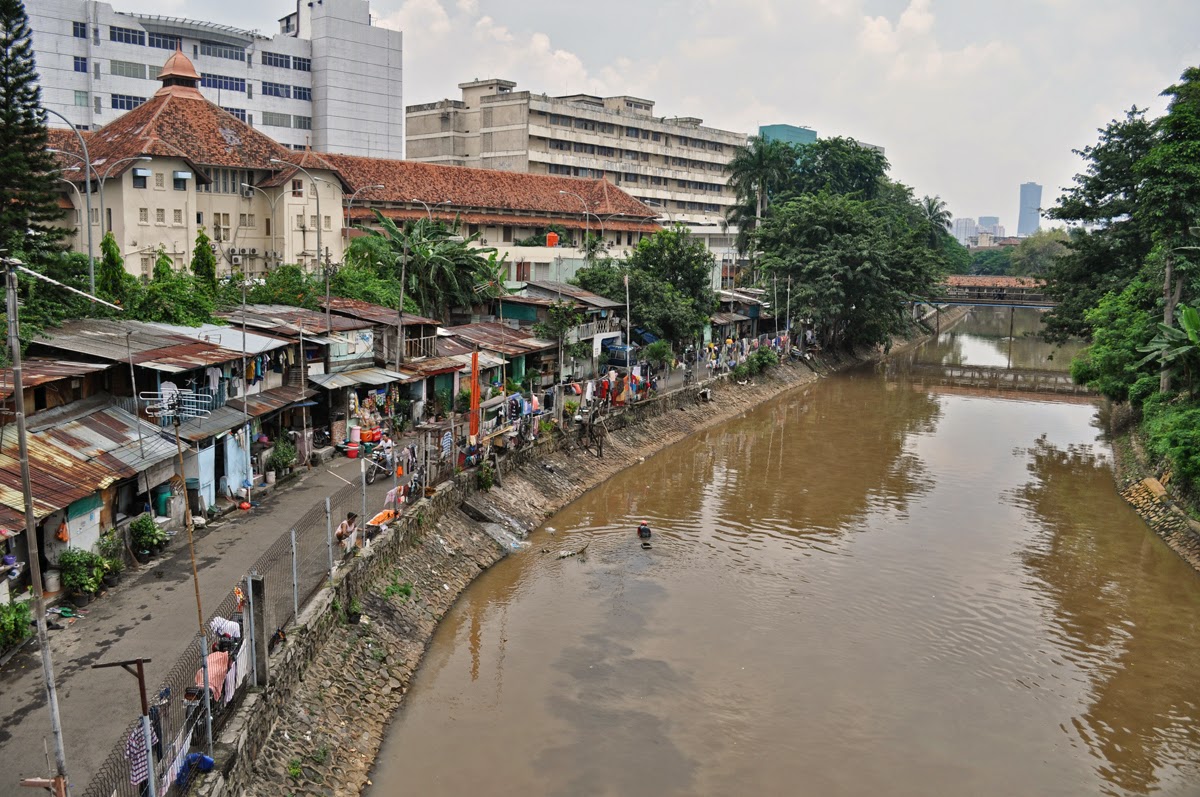
The Ciliwung watershed is an important watershed in Java in term of the size, position, and governments involved in its management. It covers 387 km2 area and 117 kilometers length. It flows from south to the north of Java Sea. It crosses 2 provinces (Jakarta and West Java province), 5 Municipalities (Bogor, Depok, South, Center, and North Jakarta) and 1 District (Bogor District). Bogor District mostly covers the upper part of watershed, Bogor Municipality covers the middle area, and Jakarta Province covers the downstream area.
Jakarta as the Capital City of Indonesia is a huge and sprawling urban areas. It located in a low, flat, and averaging 7 meters (23 ft) above sea level. The northern part of Jakarta is a plain land, where some areas below the sea level, and frequently flooding. Meanwhile, the southern parts of the city are hilly, and consequently designated for reservoirs. There are ten rivers in the south, flowing from the south towards the Java Sea in the north. The most important river in Jakarta is Ciliwung, which divides Jakarta into Western and Eastern area.
According to the Center for Watershed Management of Ciliwung-Cisadane, the issues and problems in Ciliwung watershed is complex. Specific issues and problems are being faced i.e. water supply, flood, water quality, energy, transport and institutional arrangements. Ciliwung watershed becomes a major problem of annual flood in Jakarta province. As an act of mitigation action, National Disaster Management Authority (BNPB) along with Disaster Management Authority of Jakarta Province (BPBD) has installed early warning system along Ciliwung Watershed starting from Katulampa Sluice to the Manggarai Sluice.
The efforts to conserve Ciliwung Watershed have been done by the Government, Non-Governmental Organization (NGO), Corporate Social Responsibility (CSR), community, etc. Recent actions in Ciliwung are spatial planning, Gerakan Ciliwung Bersih, flood management, Normalization of Ciliwung River, clean river program (program kali bersih – prokasih), reforestation, etc. In other hand, Indonesian government has been release some regulation on water resources management e.g. Act No. 7/2014 on Water Resources; Presidential Decree No. 33/2011 on the National Policy on Water Resources Management, etc. But the efforts are scattered, spread thin and unconnected.
Since Ciliwung Watershed covers inter-district governmental, it needs a trans-boundary as well as trans -institutional management. A term of “one river, one plan and one integrated management” is a vision to manage the river as integrated natural resources ecosystem. The weakness of institutional coordination in river management is a problem that needs to be solved and also important the availability of full time human resource as well as tools for coordinating and evaluating (information system).
The identifications of water resources issues in Indonesia have been done thoroughly, yet the available database to support problem-solving study is not interoperability and very limited. This limited database problem is related to lack of monitoring and prioritization to create a sufficient water resources database. On other side, it is also needed to develop disaster resilience communities that can enhance communities on disaster awareness.
Considering all those mentioned problems, some actions are required to bridge the problems and the goals. The actions requested to CTCN will be technical assistance/capacity building in Developing the Ciliwung Watershed Management through developing Ciliwung Knowledge Management Center (KMC) and developing disaster resilience communities. This technical assistance is targeted to local institutions (provincial government, related ministries, and R&D institutions) as well as related communities. It may cover:
- Developing Ciliwung Knowledge Management Center (Stakeholders) - Developing institutional arrangement of Ciliwung Knowledge Management Center - Developing information system of Ciliwung Knowledge Management Center
- Developing Disaster Resilience Communities (Communities) - Conducting training to the community to enhance disaster awareness - Developing community framework on disaster mitigation
Various campaigns and actions have been taken place to save Ciliwung watershed by government agencies, non-government agencies, community and society. The efforts to conserve Ciliwung watershed have been done by the Government, Non-Governmental Organization (NGO), Corporate Social Responsibility (CSR), community, etc. Recent actions in Ciliwung are spatial planning, Gerakan Ciliwung Bersih, flood management, Normalization of Ciliwung River, clean river program (program kali bersih – prokasih), and reforestation in upper part of Ciliwung Watershed.
In order to recover the quality of the environment, the Ministry of Environment and Forestry has developed five priority programs contained in the General Plan on Restoration Environmental Quality in Ciliwung Watershed, which consists of:
- Environmental Pollution Control Program,
- Environmental Damage Control Program,
- Spatial Program,
- Law Enforcement Program, and
- Community Empowerment. Some implementations programs that have been implemented to reduce the rate of destruction and pollution in Ciliwung River, such as the creation of infiltration wells and bio pore holes infiltration to reduce erosion and sedimentation, and biogas to reduce waste from livestock manure.
Ciliwung watershed management is also increasingly urgent, noticed in the policy of National Capital Integrated Coastal Development (PTPIN) - Giant Sea Wall Jakarta. Downstream watersheds that flowing into the sea must have a good quality. Thus, this project will indirectly support the Giant Sea Wall Jakarta.
Currently, National Disaster Management Authority (BNPB) and Ministry of Environment and Forestry still developing a system for collecting, managing, updating, maintaining and presenting data & information related to the data and activities management in Ciliwung Watershed into a database and information system.
CTCN expected to facilitate the realization of Ciliwung Watershed Management through developing knowledge management center and developing disaster resilience communities. The activities will sustain by optimizing the role of watershed communities and stakeholders. KMC will also be a database center and as a media that oversees a variety of interests. Establishment of a database management system on provider information is needed by various stakeholders in policy making and problem resolution. The information system should be able to perform flexible data management that capable in editing, up-dating, management and data analysis. In addition, KMC can realize the program / activity as a concrete action that has been taken as a proper policy measures to address Ciliwung watershed as well as other national strategic policy support. While, disaster resilience communities can provide community framework on disaster mitigation along with enhancing community on disaster awareness.
Assistance requested:The request is basically a kind of technical assistance to enhance the knowledge and skill of relevant stakeholders in watershed management through developing institutional arrangement and system information.
In developing institutional arrangement, it will cover:
- Capacity building for developing institutional framework of Knowledge Management Center
- Knowledge transfer on integrated water resources management, especially river basin management from international, national and to local
- Capacity building to local community to enhance environmental awareness
- Capacity building to develop support policy and regulation
In developing community framework on disaster mitigation, it will cover:
- Technical assistance to develop the system information
- Technical assistance to mapping out institutional and recent action in the Ciliwung Watershed
In Conducting training to the community to enhance disaster awareness, it will cover technical assistance and capacity building to enhance the disaster resilience awareness.
In Developing Disaster Resilience Communities (Communities), it will cover:
- Technical assistance and capacity building to develop disaster resilience communities
- Technical assistance and capacity building for mitigation disaster guideline
The activities that will be may cover:
- Establishment of organizational structure and cooperation mechanism through Focus Group Discussion (FGD), workshops and seminars
- Knowledge exchange for watershed management with FGD, workshops, seminars, and comparison study
- Data collection activities
- Establishment of KMC information system
- Empowering local communities through training and workshops in watershed management
- Establishment of disaster resilience communities
- Developing mitigation disaster guideline
- Strengthening of law enforcement
- Final workshop and dissemination
The realization of Ciliwung Watershed Management is to achieve sustainable socio-economic development through the equitable utilization of, benefit from, the common Ciliwung Watershed Management.
- In medium term, the related ministry / government institutions, developers, researchers and academics can access the database that has been built to assess and determine policy and development planning. So, it will give better chance to manage the watershed management (upstream-downstream) to tackle all specific issues and problems in Ciliwung Watershed.
- In long term, it will establish people/community to concern about the environment not only in Ciliwung Watershed but also in global environment.
After the technical assistance, it expected there will be the availability of a capable team which consists of various stakeholders that will act as advisor toward the Ciliwung Watershed. Various stakeholder involved is expected as a bridge to facilitate multi-institutional coordination in the future. Specifically, follow-up activities to be carried out after the technical assistance namely;
- The establishment of a team of experts who will oversee and provide inputs to decision makers
- Integrating long term plan from related stakeholders through KMC
- Dissemination activities to the relevant stakeholders, as well as transfer of knowledge
- Establishment of supporting regulation
- Supporting the disaster resilience communities
- Assist the monitoring and evaluation activities
- Strategic Plan Year 2015-2019 of Directorate General of Water Resources, Ministry of Public Works; the points which supports in the document are securing areas that prone to flooding of 200.000 ha and normalization of the river along 3000 km
- Master Plan of Provincial of DKI Jakarta Year 2010-2030, the points which supports in the document are infrastructure systems for utilization of water resources and its control, spatial planning in geological disaster-prone areas (conservation function), and environmental strategic area on corridor development of west & east canal, and Ciliwung River.
- Presidential Regulation No. 54 Year 2008 on Spatial Planning in Jabodetabekjur (Jakarta, Bogor, Depok, Tangerang, Bekasi dan Cianjur), the points which supports in the document are normalization of rivers and its tributaries, and stipulation of rivers priority (including Ciliwung) for structuring and normalization.
- Master Plan of Provincial of West Java Year 2009-2029, the points which supports in the document are green open spaces for river border and stipulation of Ciliwung Watershed as a provincial strategic areas.
- General Plan on Restoration Environmental Quality in Ciliwung Watershed, Ministry of Environment and Forestry, the points which supports in the document are five priority programs in Ciliwung Resources (also mentioned in Past and On-going Efforts Section).
National Disaster Management Authority along with Disaster Management Authority of Jakarta Province is interested in submitting this project and then together with the CTC Indonesia TPSA-BPPT (as CTCN Network based in Indonesia).
To develop and select this request, consultations have been conducted between the team of National Disaster Management Authority, Disaster Management Authority of Jakarta Province and the NDE Indonesia. It was discussed and agreed that main request is a kind of technical assistance and capacity building to enhance the knowledge and skill of relevant stakeholders in developing Ciliwung Watershed Management through Knowledge Management Center and Disaster Resilience Communities.
The proposal has been reviewed by NDE Technical Team and approved by NDE Steering Committee.
Expected timeframe:24 months
Key stakeholders: