Improve Environmental Sanitation in Coastal Cities in Vietnam
July 26, 2015

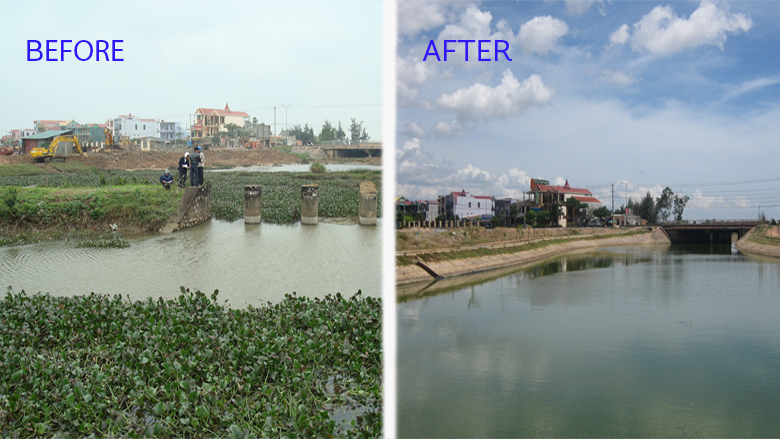
The Project provided drainage, wastewater collections and treatment plants as well solid waste management facilities and conducted a comprehensive capacity building program. More than 800,000 citizens benefited from the project with about 250,000 benefiting from reduced flooding. More than 800,000 citizens now enjoy improved solid waste management service, 66,500 students have better schools sanitation facilities; and 8,452 poor families have benefited from the received revolving fund for upgrading their toilets.
Challenge
Vietnam is one of the fastest urbanizing countries in the region, largely due to rural urban migration. Urbanization is fuelling economic growth but it also adds to the challenges to cities’ abilities to provide efficient service delivery and adequate infrastructure, especially liquid and solid wastes, and drainage.
Urban wastewater and storm waters were discharged without treatment through combined systems to nearby watercourses. Due to lack of maintenance, flooding was common in urban centers and large sections of these combined networks. Constructed decades ago, these needed rehabilitation.
The country was also producing around 15 million tons of solid waste per year, which were disposed of mainly to uncontrolled open dumping sites, with few sanitary landfills. Solid waste collection ability could only serve 70% of the urban population.
Weak capacity and low cost recovery has been also considered as a major sector’s issues.
Solution
The project used an integrated and innovative approach to address the challenges that include the following:
- Take an investment-phased approach and select appropriate technologies.
- Mark household connections and collection systems as crucial elements.
- Enhance project/contractual management.
- Conduct compensation and resettlement processes in a timely and consistent manner.
- Promote efficient institutional and regulatory arrangements at the local level. Financial commitment and address cost recovery issues.
- Place Information-Education-Communication (IEC) program for WW/SWM tariffs increase and behavior change as a top priority, to include community participation and the establishment of environmental learning centers in the participating cities.

Results
- By the end of 2014, the project helped: i) reduce the incidence and severity of flooding for 255,000 people; ii) provide solid waste collection for an additional 800,000 people; iii) provide better access to improved sanitation for more than 800,000 citizen; iv) provide better school sanitation to 66,500 students; and, v) provide a revolving fund to 8,400 poor families for upgrading their toilets and sanitation connections.
- A GEF grant, together with financing from the project, enabled the successful completion of a 14,000 m3/day capacity waste water treatment plant at Quy Nhon, which benefited about 60,000 people.
- The project supported the strengthening of Urban Environment Companies with a comprehensive program to produce accounting systems, operation and maintenance manual, a regulatory framework for private sector participation, environmental monitoring and human resource training, for better service provision.
- The project has played a catalytic role in the promulgation of important legal frameworks that help to strengthen the institutional setup of environmental sanitation in Vietnam, with clear mandates, source of revenue and with the right instrument for enforcement.
Bank Group Contribution
The World Bank’s IDA provided $190 million, together with a trust fund from the Japanese government of $4.6 million and a Global Environment Fund (GEF) grant of $5 million.
Partners
The World Bank financed similar projects in the past, and this project was prepared at a time overlapping with the closing of the Three Cities Sanitation projects, so the Bank was positioned to bring regional and international best practices into the project design and thus further develop and consolidate the country’s urban environmental policy agenda. The Bank was in close partnership with the central and local authorities of the participating cities of Nha Trang, Quy Nhon and Dong Hoi) in implementing this project.
IDA has also mobilized resources to further advance the sanitation agenda in Vietnam. The GEF has agreed to support the demonstration of a new and appropriate treatment technology in Quy Nhon, while a PHRD co-financing grant was planned to build the capacity of service providers and other relevant agencies and raise public awareness of the project.
Moving Forward
The various steps taken by the national government and provincial authorities both during project design and implementation are expected to contribute to the long term use of the physical structures and the sustainability of the operation. The cities have made choices of appropriate technology, based on the availability of land, and their expected growth. At the same time, the circulation of clearer environmental decrees supported by the project encourage and allow the use of revenue collected through penalty and user fees to cover operation and maintenance, and other operational costs.
Given the initial performance of the project, there is high degree of optimism that the next phase of the project will happen soon. The three participating provinces have proposed a combined next phase operation, and have started their planning process, taking into account different scenarios. Parallel to this, cities have also started to reach out to unconventional sources to explore new areas of income. This includes preparation to use waste for fertilizer (Dong Hoi), an initial project proposal on waste reuse for submission to the Gates Foundation and others.
Beneficiaries
Mr. Nguyen Huu Hoai, chairman of Quang Binh People's Committee: “The project has changed the landscape of Dong Hoi and added more points to its score as a 2nd tier city, which in more specific term means that 75% population and visitors can benefit from sewage and waste water treatment service. Trees have been planted on sewage canals; lighting system has also been erected; ship anchor ports have been upgraded, etc. This has made Dong Hoi a modern and environment-friendly and sustainable city”.