Biggest Lakes in the World Under Pressure From Human and Environmental Threats
June 07, 2015
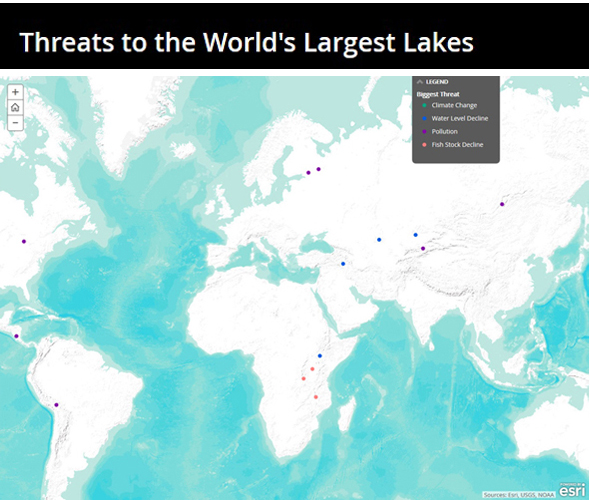
Across continents and hemispheres, a growing list of human and environmental pressures threaten the world’s largest lakes, inhibiting their ability to supply water, drive economic activity, preserve biodiversity, and sustain communities.
Across continents and hemispheres, a growing list of human and environmental pressures threaten the world’s largest lakes, inhibiting their ability to supply water, drive economic activity, preserve biodiversity, and sustain communities.
In the past year alone, water levels dropped to record lows in Iran’s Lake Urmia, a die-off of rare and ancient sponges occurred in Russia’s Lake Baikal, blooms of toxic algae shut down drinking water supplies in North America’s Lake Erie, and construction began on a major shipping canal that scientists warn could devastate Central America’s Lake Nicaragua.
Fixing these problems will be expensive both economically and politically, experts say. Failing to address them, however, will jeopardize the large lake ecosystems that underpin the economic, environmental, and cultural vibrancy of regions around the world. The Great Lakes, for example, support 1.5 million jobs and generate $US 62 billion in wages in the United States. Lake Baikal, the biggest and oldest lake in the world, is home to approximately 2,500 species of plants and animals and is such a cultural treasure in Russia that it has its own anthem. Moreover, the 10 biggest lakes in the world hold approximately two-thirds of Earth’s available fresh water, an increasingly scarce resource.
While there is an array of symptoms afflicting large lakes—from invasive species to harmful algae to declining water levels—the root cause is water management systems that are slow to put ecosystem health above industrial and agricultural interests. Lakes in developed countries suffer from the legacy of this model, and lakes in the developing world are at risk from managers repeating the same mistakes.
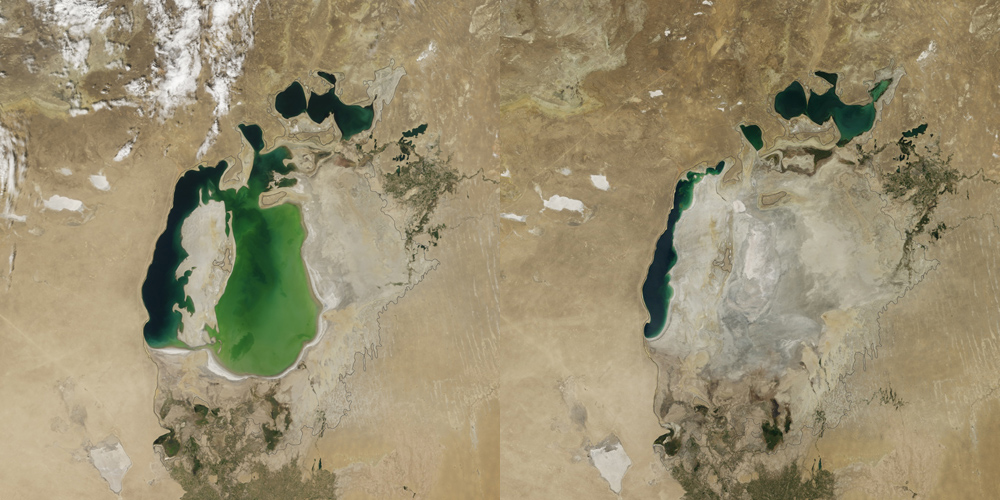
Despite their size, history has shown that even the biggest lakes are vulnerable to human influence. In 1969, Lake Erie was so polluted that one of its tributaries caught fire. The Aral Sea, once the fourth largest lake on Earth, is now so shriveled from water diversions that it no longer makes the top 15.
“The characteristics of the problem or the specifications of the problem are different from one location to another,” Kaveh Madani, a lecturer of environmental management at the Imperial College of London who has studied Lake Urmia, told Circle of Blue. “That’s why many times we don’t know how we need to deal with these things, and once a crisis occurs, we get surprised by the different symptoms that appear. Many times we don’t know what to do, or it is ultimately too late to take an action. Natural systems have some level of threshold—they are resilient, they can tolerate some level of disturbance and injury—but once you pass that it’s too late, the system might not be recoverable. That is the situation I think we are seeing in Lake Urmia and the Aral Sea, and lots of other places.”
During a public lecture in April, Robert Sterner, director of the Large Lakes Observatory at the University of Minnesota-Duluth, summed up humanity’s ability to either threaten or protect large lake ecosystems.
“We are in control,” he told the audience. “It is not only the sun and gravity controlling Earth’s water. It’s our decisions that basically are in control today of the Earth’s hydrological cycle.”
Lake Urmia: A Victim of Human-Influenced Drought
Central Asia provides some of the most striking displays of human influence on big lakes. Satellite photographs show the Aral Sea, straddling the border of Uzbekistan and Kazakhstan, receding from a robust water body to little more than a sliver between the 1960s and today. Last October, a NASA image revealed that the lake’s large eastern basin had dried up completely.
Like the Aral Sea before it, Lake Urmia—a vast, shallow, saltwater lake in northwestern Iran—is also shrinking rapidly. The surface area of the lake has declined 88 percent since the 1970s, according to a study published in the Journal of Great Lakes Research in March. Tourism in the region has fallen with the water levels. Serious health risks are on the rise as dust storms pick up salts from the exposed lake bottom, sweeping them across towns and farm fields.
Lake Urmia has been plagued with droughts during the past decade, but cycles of water scarcity are nothing new in the arid region, researchers say. The March study found that the frequency of droughts affecting Lake Urmia has not increased significantly.
“Obviously, low average precipitation reduces the runoff that the lake receives from adjacent lands and effects the river flow,” Ali Mirchi, a post-doctoral research associate at Michigan Technological University and one of the study’s authors, told Circle of Blue. “Drought has natural negative impacts on lake inflow, but Lake Urmia has survived more severe droughts in its history. As far as drought goes, nothing has changed to the level that would cause this massive shoreline retreat and shrinkage.”
Instead, water management decisions influencing the flow of freshwater rivers that supply the lake are likely to blame for the disappearing lake water. Iran is constructing dams to supply expanding agricultural fields that siphon water away from the lake, much like the expansion of cotton fields in the mid-20th century led to the drying of the Aral Sea. The result is a “socioeconomic drought,” explained the Imperial College’s Madani, another of the study’s authors. A socioeconomic drought is simply a human-made drought, created when demand for water outstrips the supply, Madani said. It is not unique to Lake Urmia or to Iran.
“When it comes to users of water—farmers, factories on the coast—everyone is trying to maximize their short-term benefits,” Madani told Circle of Blue. “When the government is not thinking about the future, this results in operating in a crisis management mode rather than a proactive mode. It is something you see all over the developing world, without any concern for the future. It is a problem you also see in the U.S., where [leaders] are not concerned about emissions and climate change.”
Iran, like other developing countries, is in an era of “hydrologic mission,” according to Madani. The country is trying to reap as much economic gain from its water as possible, with little regard to the environmental outcomes. Similar situations are playing out in China, where projects like the South-North Water Transfer Project are moving massive amounts of water out of the Yangtze River basin to supply economic development, and in California, where water supply projects have led to the drying of the state’s largest lake, the Salton Sea.
One point I want to emphasize is, they are not stupid, in the sense that we have also been stupid some time in the past,” Madani said. “We shouldn’t look at them and say, ‘Oh wow, these guys don’t know what they’re doing.’ It’s sad that they are repeating the same mistakes. So they could have at least learned from mistakes the West has made in the past, but the nature of the problems is similar. The question is, can they also respond in a timely manner?”
Hassan Rouhani, Iran’s president, vowed to save the lake during his election campaign, and last year approved a $US 500 million plan to restore it. The government has also acknowledged that the dropping water levels are a man-made problem, not just the result of natural droughts.
“Lake Urmia can be restored, physically it can be restored, but the cost of restoration is high economically, politically, and socially,” Madani said. “International agencies can act like catalyzers to help the process.”
Lake Baikal: Algae Mars Biggest of the Big Lakes
Large lakes are under duress not only in the developing world, but also in countries like Russia and the United States. Algae blooms, caused by an excess of nutrients from fertilizers and sewage washing into the water, are one of the most widespread and troubling issues afflicting lakes in developed countries. Nutrient pollution, known as eutrophication, has long turned small, inland lakes green with scum—some of it toxic to fish and other animals. Over the second half of the 20th century, the problem also emerged in large lakes like Lake Erie in North America, Lake Victoria in Africa, and Lake Taihu in China. Even Siberia, home to Lake Baikal, the world’s deepest and most ancient lake, has not been spared.
“[Lake Baikal] is very important to all people in Russia,” Marianne Moore, a professor of biology at Wellesley College who has studied the lake for the past 15 years, told Circle of Blue. “It is an icon that represents the unspoiled wilderness of the Russian motherland. It is very much like the Grand Canyon or Yellowstone National Park is for Americans. As far as I know, it is the only lake in the world that has an anthem that is written about it, and all people in Russia either know it or are familiar with that anthem.”
Excessive nutrients, most likely from outdated sewage treatment facilities in coastal cities, are now spoiling the waters of Baikal with waves of an alga called Spirogyra. During the fall of 2013, researchers found blooms of the algae along the northwest coast of the lake, near the town of Severobaikalsk and the estuary of the Tyya river.
“Rolling waves threw a viscous black and green organic matter which formed on the coast foul-smelling swells stretching for hundreds of meters,” says an English translation of a report describing the incident. The report, published in Russian media outlet Science Firsthand, was written by Oleg Timoshkin, a researcher at the Irkutsk Limnological Institute.
The unsightly blooms are a detriment to tourism, and scientists are not yet sure what effect, if any, they will have on Baikal’s unique biodiversity. Despite its icy cold waters, the lake hosts thousands of species of plants and animals. The majority of them are endemic, meaning they live nowhere else in the world. In the past two years, researchers found that certain lake sponges, some of which take hundreds of years to grow, are dying en masse. The cause of the deaths is unknown, and it is unclear if they are linked to the algal blooms.

Another threat could come from proposed hydropower and water diversion projects in the Selenga River basin, the primary tributary to Lake Baikal. Much of the basin lies in Mongolia, which is planning two dams—one on the Selenga River to produce hydropower and one on the Orkhon River to supply water to mining projects in the Gobi desert. In February, the environmental organization Greenpeace sent a petition protesting the dams to the World Bank, which is backing the projects.
“This is an extraordinary system,” said Moore, who signed the Greenpeace petition. “It is one of the most unusual freshwater lakes in the world, and one of the things we need to keep in mind is that it is the largest body of liquid freshwater on the planet. It contains more water than all of the Great Lakes combined. It is an extraordinary resource, particularly for those parts of the world that need water. I’m thinking of Mongolia and China. In my opinion, it would be a crime to humanity to pipe water out of that lake for agricultural reasons to the south, or something like that.”
Source: circleofblue.org